It was that time of year again when I cleaned up my summer garden, pulling blighted and dried up tomato plants, shriveled vines, and sundry weeds to pile in the compost. I watered and watered and hardly got one tomato that wasn't split or blossom-rotted, so it felt good to wipe the slate clean, to discard the frustration and failings of a dry summer. Now that the rains are returning, my plans were to put out some cool weather crops like spinach, cabbage, and fennel.
It had been a while since I did something with my four-year-old daughter, so I took her with me to the back yard. As much as I enjoy playing Barbies or Teddy Bear dress-up, I savor the times when I can do work outside that doubles as play time for her. I got out her pink wheelbarrow and plastic rake and shovel, along with my own wheelbarrow and yard tools, and began pulling up the tomato cages while she yanked up clumps of grass. It takes twice as long when she helps, but I wasn't in a hurry as there is still plenty of daylight in the afternoons. When we were finished, we carted it all off to the compost pile at the edge of the woods. Then it came time to till. She was right in there with her yellow plastic shovel, hacking at the dry ground and throwing dirt in the air over her shoulder. I wanted to tell her to let me soften the ground with my mattock first and then she could make little rows for the seeds, and tried explaining to her just that. Her efforts were futile, but she was having too much fun.
Her efforts reminded me of how many times I concern myself so much with getting to the end result, that I don't enjoy the process of doing it. My grandpa told me as a child many times that I wasn't doing something right, then make me watch while he showed me the correct process. He meant well, of course, but by then I had lost all interest in what I was doing. Sometimes, there are more ways of doing things than the right way or the wrong way. For my daughter, it was the "fun" way, maybe the "longer" way, but not necessarily the "wrong" way. So I gave her some room and let her sling that yellow plastic shovel. While I tilled the rest of the garden, I gave her room to dig her little four-inch-wide hole, where I later let her plant some cilantro. There will be time when she's older for lessons on spacing and planting depth, and all those other little nuances of gardening.
Wednesday, September 19, 2007


Thursday, September 13, 2007
Poem
The Summer Camp of Love
I was so high that summer
- - - - - The world was unclouded and bright
- - - - - - - - -Taking hits off the Holy Spirit
- - - - - - - - - at the Chapel Woods campfires
- - - - - - - - - - - - - - -Getting ready for the bridegroom
- - - - - - - - - - - - - - -Trimming our wicks, we knew
- - - - - - - - - He was coming with sound of trumpets
- - - - - - - - - And we would forever stand atoned.
- - - - - For those who repented of their sins,
cast their earthly vices aside,
- - - - - were the first to get stoned.
from Iodine Poetry Journal 9:2 (Fall/Winter 2008/2009) 40.
I was so high that summer
- - - - - The world was unclouded and bright
- - - - - - - - -Taking hits off the Holy Spirit
- - - - - - - - - at the Chapel Woods campfires
- - - - - - - - - - - - - - -Getting ready for the bridegroom
- - - - - - - - - - - - - - -Trimming our wicks, we knew
- - - - - - - - - He was coming with sound of trumpets
- - - - - - - - - And we would forever stand atoned.
- - - - - For those who repented of their sins,
cast their earthly vices aside,
- - - - - were the first to get stoned.
from Iodine Poetry Journal 9:2 (Fall/Winter 2008/2009) 40.
Friday, September 7, 2007
Those Who Can't, Teach
Walt Whitman worked for a while as a teacher in series of windowless, poorly heated, one-room schoolhouses for almost no money. While teaching at one school, he wrote to a friend, "How tired and sick I am of this wretched, wretched hole! — ... O, damnation, damnation! Thy other name is school-teaching." --- from The Writer's Almanac
There's an old saying that goes, "Those who can, do. Those who can't, write." Or there is the other adage, "Those who can, do. Those who can't, teach." Though I don't always like my job (and who doesn't hate their job at times), I have a problem with people who believe this. In one aspect, I sometimes wish I could devote my entire day to my writing. I feel I would not only become better at it, but would eventually find a publisher and be able to sell my work. However, I have a family to support, and no guarantee that weeks and months and years of writing would produce a New York Times best seller, thus pulling me out of the grips of poverty. So I teach. People who have never taught have trouble understanding that it takes more than knowing something to teach it. I know a little bit about a lot of things, and a lot about some things, but getting in front of people who generally have no interest in what you are saying to begin with, and present this lesson of information in such a way to be both interesting and entertaining, is a daunting task. Then there is the issue of maintaining discipline in the classroom. Some teachers are such pushovers that students can get away with anything and, therefore, learn nothing. There are also some teachers that are so strict that flexibility and creativity are stifled and learning becomes a military drill that most students buckle under and give up. I would say that managing behavior and discipline in class is three-fourths the job of teaching in a public school, and if that can't be accomplished it doesn't matter how brilliant of a mind the person has. I can do any job that someone throws at me, and I have done many (dishwasher, busboy, pizza delivery, meat clerk, landscaping), but the hardest job I have ever worked at is what I am doing now, teaching. And its the hardest jobs that one must love in order to keep coming back to it day after day.
So as much as I agree with Whitman's sentiment above, I will have to say that I do "do." I live, I write, I teach.
There's an old saying that goes, "Those who can, do. Those who can't, write." Or there is the other adage, "Those who can, do. Those who can't, teach." Though I don't always like my job (and who doesn't hate their job at times), I have a problem with people who believe this. In one aspect, I sometimes wish I could devote my entire day to my writing. I feel I would not only become better at it, but would eventually find a publisher and be able to sell my work. However, I have a family to support, and no guarantee that weeks and months and years of writing would produce a New York Times best seller, thus pulling me out of the grips of poverty. So I teach. People who have never taught have trouble understanding that it takes more than knowing something to teach it. I know a little bit about a lot of things, and a lot about some things, but getting in front of people who generally have no interest in what you are saying to begin with, and present this lesson of information in such a way to be both interesting and entertaining, is a daunting task. Then there is the issue of maintaining discipline in the classroom. Some teachers are such pushovers that students can get away with anything and, therefore, learn nothing. There are also some teachers that are so strict that flexibility and creativity are stifled and learning becomes a military drill that most students buckle under and give up. I would say that managing behavior and discipline in class is three-fourths the job of teaching in a public school, and if that can't be accomplished it doesn't matter how brilliant of a mind the person has. I can do any job that someone throws at me, and I have done many (dishwasher, busboy, pizza delivery, meat clerk, landscaping), but the hardest job I have ever worked at is what I am doing now, teaching. And its the hardest jobs that one must love in order to keep coming back to it day after day.
So as much as I agree with Whitman's sentiment above, I will have to say that I do "do." I live, I write, I teach.
Wednesday, September 5, 2007
Hillsville Flea Market and The Battery-Powered Squirrel

Flea markets, you either love them or hate them. If you live in Hillsville, Virginia, however, it doesn't make much difference. In a town where the average population is 2,700, come Labor Day weekend the number of bodies soar to 650,000 -- that's on average the number of people who visit every Labor Day weekend to brave the crowds, mud, and shopping buggies (and the occasional motorized scooter) all in the name of a good find.
I spent seven years of my childhood in Hillsville, Virginia, and learned early on the history of its Labor Day flea market. Starting as a gun and knife show at the VFW building and parking lot, over the years it spilled across West Stuart Drive down what's called Hunley's Field. Like a kudzu vine it twisted its way up both sides of the street to the downtown area of Hillsville and another large section called Bowman's Field. If you walked every aisle in town it would take you all day. If you walked every aisle and looked at even half of the booths and vendors it would take you all weekend, and even then you might not see it all. In middle school, my friends and I would ride our bikes into town and ditch them behind the elementary school, then proceed to walk around for the remainder of the day looking at stuff. We mostly bought cheap Rambo-style survival knives, ninja throwing stars, coins, baseball cards, or comic books. Today a few friends and I meet every year to walk the rows and look for interesting items (seen above: Alan, Marty, and me). Of course, there is a lot of the same junk, and some outrageous prices for that junk, but there are also good finds to be had, and some pretty odd finds as well.
A few years ago my friends and I began scoping the booths for the oddest items we could find, seeing who could come up with the strangest, kitschiest, most outrageous item imaginable, or whatever tickled our funny bone. My friend Alan discovered a toy vendor who had something called The Battery-Powered Squirrel, in its original box. Underneath the title it boasted "with secret mystery action." Well, we just had to find out what that secret mystery action was, but the guy would only open the box to let us look at it. Inside was something that looked like roadkill. It's natural animal fur was peeling away from its metal body. The guy wanted $125 for it. Needless to say, we didn't buy it, but we've been on the lookout for it again ever since. This past Saturday we came across two items, a ceramic bank of Santa Claus holding a kitten riding on the back of a pig -- $100 (Alan would have bought it if it had one less zero in it) and a mechanical toy in its original box called The Happy Naughty Chimp (no secret mystery action, though). I almost bought it, but thought my children would just be scared by it. Marty found a captain's hat, but wouldn't buy it even though I told him I would put on a wig and be Tennille. We topped our morning's search off with lunch at the local Mexican restaurant, the Rio Grande. Some chimichangas and a pitcher of Dos Equis hit the spot, and gave us inspiration to walk around for a few more hours. No Battery-Powered Squirrel was to be found, but there is always next year.
I spent seven years of my childhood in Hillsville, Virginia, and learned early on the history of its Labor Day flea market. Starting as a gun and knife show at the VFW building and parking lot, over the years it spilled across West Stuart Drive down what's called Hunley's Field. Like a kudzu vine it twisted its way up both sides of the street to the downtown area of Hillsville and another large section called Bowman's Field. If you walked every aisle in town it would take you all day. If you walked every aisle and looked at even half of the booths and vendors it would take you all weekend, and even then you might not see it all. In middle school, my friends and I would ride our bikes into town and ditch them behind the elementary school, then proceed to walk around for the remainder of the day looking at stuff. We mostly bought cheap Rambo-style survival knives, ninja throwing stars, coins, baseball cards, or comic books. Today a few friends and I meet every year to walk the rows and look for interesting items (seen above: Alan, Marty, and me). Of course, there is a lot of the same junk, and some outrageous prices for that junk, but there are also good finds to be had, and some pretty odd finds as well.
A few years ago my friends and I began scoping the booths for the oddest items we could find, seeing who could come up with the strangest, kitschiest, most outrageous item imaginable, or whatever tickled our funny bone. My friend Alan discovered a toy vendor who had something called The Battery-Powered Squirrel, in its original box. Underneath the title it boasted "with secret mystery action." Well, we just had to find out what that secret mystery action was, but the guy would only open the box to let us look at it. Inside was something that looked like roadkill. It's natural animal fur was peeling away from its metal body. The guy wanted $125 for it. Needless to say, we didn't buy it, but we've been on the lookout for it again ever since. This past Saturday we came across two items, a ceramic bank of Santa Claus holding a kitten riding on the back of a pig -- $100 (Alan would have bought it if it had one less zero in it) and a mechanical toy in its original box called The Happy Naughty Chimp (no secret mystery action, though). I almost bought it, but thought my children would just be scared by it. Marty found a captain's hat, but wouldn't buy it even though I told him I would put on a wig and be Tennille. We topped our morning's search off with lunch at the local Mexican restaurant, the Rio Grande. Some chimichangas and a pitcher of Dos Equis hit the spot, and gave us inspiration to walk around for a few more hours. No Battery-Powered Squirrel was to be found, but there is always next year.
Wednesday, August 22, 2007
Poem
Aunt Beulah Sounds Off
A pioneer-island in a world that has
no use for pioneers – the unsplit rock
of Fundamentalism, calomel
clan-virtues, clannish vices, fiddle tunes
and a hard God.
--Stephen Vincent Benét
Don't call us backward.
We walk in the same direction as you,
just not in such a hurry to discard
the old for the new.
We're content with our pace, thank you.
Sure, while you may have been the first
on your block to listen to your records in stereo,
to install an 8-track player in your Pinto,
to fill your CD tower with the latest music,
we were already making our own,
hewing out tunes on fiddle, dulcimer, and banjo,
not from woofers or tweeters, but from our own hands it flowed.
Restless and discontent city-folk
with your throw-away culture,
media-stoked and commercially corrupt,
defiling your identity,
defining yourselves with store-bought trinkets,
and what you can't buy right away, you rent,
no money down and take years and years to pay.
I'm sorry, but that's just not our way.
And we aren't so out of touch
that we don't know
about microwave ovens and bread machines,
but biscuits rise better
in four hundred degrees
of cast iron and oak kindling.
Microwaves are good for warming coffee,
but not cold kitchens in winter.
As for chopping firewood, my callused hands can deal with the splinters.
Tradition is our identity,
and change does come slow, I'll admit.
But when it does, we don't forget
how we were raised, preserving,
passing on the memories
of the way things used to be.
You say it's not your bag, and that's just fine with me.
in Pine Mountain Sand & Gravel 7 (Fall 1999) 27.
A pioneer-island in a world that has
no use for pioneers – the unsplit rock
of Fundamentalism, calomel
clan-virtues, clannish vices, fiddle tunes
and a hard God.
--Stephen Vincent Benét
Don't call us backward.
We walk in the same direction as you,
just not in such a hurry to discard
the old for the new.
We're content with our pace, thank you.
Sure, while you may have been the first
on your block to listen to your records in stereo,
to install an 8-track player in your Pinto,
to fill your CD tower with the latest music,
we were already making our own,
hewing out tunes on fiddle, dulcimer, and banjo,
not from woofers or tweeters, but from our own hands it flowed.
Restless and discontent city-folk
with your throw-away culture,
media-stoked and commercially corrupt,
defiling your identity,
defining yourselves with store-bought trinkets,
and what you can't buy right away, you rent,
no money down and take years and years to pay.
I'm sorry, but that's just not our way.
And we aren't so out of touch
that we don't know
about microwave ovens and bread machines,
but biscuits rise better
in four hundred degrees
of cast iron and oak kindling.
Microwaves are good for warming coffee,
but not cold kitchens in winter.
As for chopping firewood, my callused hands can deal with the splinters.
Tradition is our identity,
and change does come slow, I'll admit.
But when it does, we don't forget
how we were raised, preserving,
passing on the memories
of the way things used to be.
You say it's not your bag, and that's just fine with me.
in Pine Mountain Sand & Gravel 7 (Fall 1999) 27.
Tuesday, August 21, 2007
View From Rough Ridge
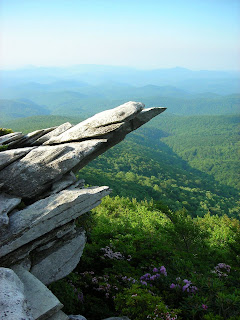
One of countless scenic views along the Blue Ridge Parkway, Rough Ridge is just about a mile north of the Linn Cove Viaduct (near Linville, NC), and a short (albeit strenuous) hike up a trail. Spring and early summer is the best time to visit, as the white Mountain Laurels and pink Rhododendrons are in bloom, seen here. Late summer and early fall are also great times as the rare Blue Ridge Goldenrod and Heller's Blazing Star are in bloom, both on the Federal Endagered Species list. I'm hoping to head back up there before the leaves start changing color to get some more photos.
This view is looking south.
Thursday, August 9, 2007
Bluewashing the Mountaineer
I just read an interesting article in the Winter 2007 issue of the Appalachian Journal about a trend in media and popular culture towards the portrayal of the Hillbilly or rural stereotype. Back in the late '60s, there was a huge movement in pop culture toward the portrayal of mountain and rural life, for good or bad, as seen for example in television shows such as Beverly Hillbillies, Green Acres, and Hee Haw, not to mention the extensive advertising of Mountain Dew's "It'll tickle yore innards" or "Get that barefoot feeling," ending, I believe, with the cancellation of the Dukes of Hazzard in 1984 (at the hands of a ratings battle with Knight Rider, a sleeker, more modern hot rod). Since then, the media's fascination with rural, redneck America has been in a lull. According to Douglas Reichert Powell, the author of this article, the country, rural, hillbilly stereotype is making a comeback, a renaissance if you will.
With the popularity of O Brother, Where Art Thou?, there has been a revisiting of rural stereotypes in movies and television. Powell's main focus is on the television show My Name is Earl, which milks both the noble mountaineer stereotype (country folk are essentially good people) and the hillbilly fool (country folk are ignorant, white trash, and laughable) There is also the hillbilly as monster and sexual predator stereotype (see movies such as Deliverance, A Face in the Crowd, and Baby Doll), but that could be a whole other discussion by itself. I tend to agree on most points with Powell's argument, but I feel that the stereotypes are no more in the forefront of the media today than they have been in the past 20 years, or at least I feel he didn't quite make his point in the article. Stereotypes have always served the same purpose -- to allow society to recognize an individual by attaching a group label. Granted, stereotypes always contain kernels of truth. There are people in Appalachia with bad oral hygeine who married their first cousin and live in a trailer with three or more dogs under their porch. But that doesn't mean it's fair to attach those characteristics to everyone who lives in Appalachia. I agree the most with Powell that when shows such as My Name is Earl try to challenge a white trash stereotype, there is an irony there that "[the media] need[s] the legibility, the recognizability of the stereotypes they propose to undermine in order to get the audience undermining the stereotypes with them." Despite how bad stereotypes are, then, they serve a purpose and are necessary, even for the purpose to turn right around and challenge or destroy them. Though Powell did use the term "hillbillyland" in the first first sentence of his article, he didn't give credit to the author who coined the term, J.W. Williamson, and wrote the book on hillbilly stereotypes in the media, Hillbillyland: What the Movies Did to the Mountains & What the Mountains Did to the Movies (1995).
I close with this final thought. If the masses of America need stereotypes, simple labels, to define an individual or a character in a television show, what does that say about the imagination of the American public?
Source: Powell, Douglas Reichert. "'Bluewashing' the Mountaineer: A Recent Television Trend" Appalachian Journal: A Regional Studies Review. 34:2 (Winter 2007) 206.
With the popularity of O Brother, Where Art Thou?, there has been a revisiting of rural stereotypes in movies and television. Powell's main focus is on the television show My Name is Earl, which milks both the noble mountaineer stereotype (country folk are essentially good people) and the hillbilly fool (country folk are ignorant, white trash, and laughable) There is also the hillbilly as monster and sexual predator stereotype (see movies such as Deliverance, A Face in the Crowd, and Baby Doll), but that could be a whole other discussion by itself. I tend to agree on most points with Powell's argument, but I feel that the stereotypes are no more in the forefront of the media today than they have been in the past 20 years, or at least I feel he didn't quite make his point in the article. Stereotypes have always served the same purpose -- to allow society to recognize an individual by attaching a group label. Granted, stereotypes always contain kernels of truth. There are people in Appalachia with bad oral hygeine who married their first cousin and live in a trailer with three or more dogs under their porch. But that doesn't mean it's fair to attach those characteristics to everyone who lives in Appalachia. I agree the most with Powell that when shows such as My Name is Earl try to challenge a white trash stereotype, there is an irony there that "[the media] need[s] the legibility, the recognizability of the stereotypes they propose to undermine in order to get the audience undermining the stereotypes with them." Despite how bad stereotypes are, then, they serve a purpose and are necessary, even for the purpose to turn right around and challenge or destroy them. Though Powell did use the term "hillbillyland" in the first first sentence of his article, he didn't give credit to the author who coined the term, J.W. Williamson, and wrote the book on hillbilly stereotypes in the media, Hillbillyland: What the Movies Did to the Mountains & What the Mountains Did to the Movies (1995).
I close with this final thought. If the masses of America need stereotypes, simple labels, to define an individual or a character in a television show, what does that say about the imagination of the American public?
Source: Powell, Douglas Reichert. "'Bluewashing' the Mountaineer: A Recent Television Trend" Appalachian Journal: A Regional Studies Review. 34:2 (Winter 2007) 206.
Saturday, July 28, 2007
Poem
Posteriors in Perspective
festive
festoons of
fabulous fannies
down the sidewalk
march proudly behind
women who know
what a caboose is
pedaling
bicycle buns
perch precariously
on tiny padded pedestals
and watch from above
while the legs
get all the credit
shivering
skinny dipping
bare white buns
shining in the sun
laughing, swimming
not so secretly
among sweet shrubs
and the summer shade
of rhododendrons
wonderful
wide loads
dimple-cheeked thighs
wearing elastic pants
wandering the aisles
at Wal-Mart
and whispering
against one another
as they brush past
with their shopping carts
Daisy Dukes
double take
low riding and
dropping out the back
should be a sin
mere inches of ragged
Levi demons
daringly dressed or
denim deficient?
it depends on the degree
of degradation
festive
festoons of
fabulous fannies
down the sidewalk
march proudly behind
women who know
what a caboose is
pedaling
bicycle buns
perch precariously
on tiny padded pedestals
and watch from above
while the legs
get all the credit
shivering
skinny dipping
bare white buns
shining in the sun
laughing, swimming
not so secretly
among sweet shrubs
and the summer shade
of rhododendrons
wonderful
wide loads
dimple-cheeked thighs
wearing elastic pants
wandering the aisles
at Wal-Mart
and whispering
against one another
as they brush past
with their shopping carts
Daisy Dukes
double take
low riding and
dropping out the back
should be a sin
mere inches of ragged
Levi demons
daringly dressed or
denim deficient?
it depends on the degree
of degradation
Friday, July 27, 2007
More Poetry for the Masses
I'll be the first one to admit that the people who tend to admire poetry the most are also poets themselves. Sometimes a clever metaphor or allusion is lost on those who are not used to reading poetry. Poetry tends to be more concise, to say more with fewer words. Like eating Campbell's condensed soup straight from the can, poetry can be a little strong for many palates. From my high school students, to my parents, to even my wife, poetry is not something that is usually read. It wasn't always that way, though. At one time, poetry was included in newspapers and popular magazines. Many poets became household names, such as the Fireside Poets of the 19th century, or such poets as Robert Frost or Maya Angelou. I wonder, though, if the fault lies entirely with the modern, technology-savy-yet-unliterate average Joe or possibly with poets themselves.
In an essay written by John Barr, president of the Poetry Foundation, entitled "American Poetry in the New Century," Barr declared, "American poetry is ready for something new because our poets have been writing in the same way for a long time now. There is fatigue, something stagnant about poetry being written today." Poetry has been largely absent from public life, whether the classroom, bookstore, newspaper, or mainstream media, they all have "a morale problem," that poems are written only with other poets in mind. For that reason, according to Barr, they do not sell. He thinks poets need to write poetry that is more robust, resonant, and above all, entertaining. In one section of the essay entitled, "Live Broadly, Write Boldly," he urged poets to be like Hemingway and seek experience outside of the poetry circles or academia establishments. Take a safari, run with the bulls, go marlin fishing, just get out and experience life. That is what he believes the public will connect with -- real life.
I think Billy Collins is such a successful poet (having sold over 500,000 books of poetry) because of this, besides the fact that he is good at what he does. He comes to the reader unpretentious with poems about everyday occurences that end up being slightly more than that, and leaves us with something understandable to think about. I am no Billy Collins (watch him to become a household name someday), but I strive in my own writing to appeal not just to the poet but to anybody willing to take the time to read a poem. Am I successful in this? I think the jury is still deliberating on that.
Source: Goodyear, Dana. "The Moneyed Muse." The New Yorker. February 19 & 26, 2007. 122-135.
In an essay written by John Barr, president of the Poetry Foundation, entitled "American Poetry in the New Century," Barr declared, "American poetry is ready for something new because our poets have been writing in the same way for a long time now. There is fatigue, something stagnant about poetry being written today." Poetry has been largely absent from public life, whether the classroom, bookstore, newspaper, or mainstream media, they all have "a morale problem," that poems are written only with other poets in mind. For that reason, according to Barr, they do not sell. He thinks poets need to write poetry that is more robust, resonant, and above all, entertaining. In one section of the essay entitled, "Live Broadly, Write Boldly," he urged poets to be like Hemingway and seek experience outside of the poetry circles or academia establishments. Take a safari, run with the bulls, go marlin fishing, just get out and experience life. That is what he believes the public will connect with -- real life.
I think Billy Collins is such a successful poet (having sold over 500,000 books of poetry) because of this, besides the fact that he is good at what he does. He comes to the reader unpretentious with poems about everyday occurences that end up being slightly more than that, and leaves us with something understandable to think about. I am no Billy Collins (watch him to become a household name someday), but I strive in my own writing to appeal not just to the poet but to anybody willing to take the time to read a poem. Am I successful in this? I think the jury is still deliberating on that.
Source: Goodyear, Dana. "The Moneyed Muse." The New Yorker. February 19 & 26, 2007. 122-135.
Tuesday, July 17, 2007
A Magnificent Time at Malaprops

This past weekend’s reading of SAWC members at Malaprops was a success! Granted, only 20 people were in the audience, seven of them being those of us who were reading our work, but we had fun and I think the rest of the audience enjoyed it too. It was also a good opportunity to promote our new issue of Pine Mountain Sand & Gravel, our yearly literary journal.
Several of us stayed at Jim Hinsdale’s house the night before, and drove up from Tryon to Asheville Sunday morning. We did a little walking around beforehand. Jim Webb (of “Get In, Jesus” fame) bought a pair of sandals at Mast General Store. Dana Wildsmith made a comment on the friendliness and energy that seemed to exude from the passersby on the street. Asheville is an eclectic city, you have to admit. As we were walking back up the street toward the obelisk, we were stopped by a girl who honestly admitted she was having a bad day and hoped one of us would buy her a beer. So floored by her frankness, Jim gave her a few dollars and told her he hoped her day got better.
We decided a beer was a good idea, so we popped in to the bar across the street from Malaprops, where Frankie Finley and Jim Minick were also meeting us. I’m not a big drinker (anymore), but I was a tad anxious, so a tall ale was just what my nerves needed. Hilda Downer and Jane Hicks were waiting in Malaprops when we arrived. Jim Hinsdale was also there with his wife Kay, and he opened the reading for us. I read three poems, the first one being “A Picture’s Worth,” which is included in the new issue. I think I did well. I might have tripped over a word or two, but I didn’t care (thank you, C2H5OH). The events coordinator at Malaprops said we were welcome to schedule another reading like this next year, so I guess we passed the audition, so to speak. For anyone who would like to pick up a copy of volume 12 of Pine Mountain Sand & Gravel for only $5 (or back issues for only $4), please contact me at: hillbillyland2@yahoo.com or our editor, Frankie Finley at: frankiefinley@yahoo.com. By the way, check out the cover art. Frankie’s partner Beth is a landscape architect and artist., and did an excellent job.
Several of us stayed at Jim Hinsdale’s house the night before, and drove up from Tryon to Asheville Sunday morning. We did a little walking around beforehand. Jim Webb (of “Get In, Jesus” fame) bought a pair of sandals at Mast General Store. Dana Wildsmith made a comment on the friendliness and energy that seemed to exude from the passersby on the street. Asheville is an eclectic city, you have to admit. As we were walking back up the street toward the obelisk, we were stopped by a girl who honestly admitted she was having a bad day and hoped one of us would buy her a beer. So floored by her frankness, Jim gave her a few dollars and told her he hoped her day got better.
We decided a beer was a good idea, so we popped in to the bar across the street from Malaprops, where Frankie Finley and Jim Minick were also meeting us. I’m not a big drinker (anymore), but I was a tad anxious, so a tall ale was just what my nerves needed. Hilda Downer and Jane Hicks were waiting in Malaprops when we arrived. Jim Hinsdale was also there with his wife Kay, and he opened the reading for us. I read three poems, the first one being “A Picture’s Worth,” which is included in the new issue. I think I did well. I might have tripped over a word or two, but I didn’t care (thank you, C2H5OH). The events coordinator at Malaprops said we were welcome to schedule another reading like this next year, so I guess we passed the audition, so to speak. For anyone who would like to pick up a copy of volume 12 of Pine Mountain Sand & Gravel for only $5 (or back issues for only $4), please contact me at: hillbillyland2@yahoo.com or our editor, Frankie Finley at: frankiefinley@yahoo.com. By the way, check out the cover art. Frankie’s partner Beth is a landscape architect and artist., and did an excellent job.
Monday, July 9, 2007
Poem
Hi-Fi Stereotype
“And after all that is come upon us for our evil deeds,
and for our great trespass, seeing that thou our
God hast punished us less than our
iniquities deserve and hast given us
such deliverance as this;”
Ezra 9:13
When John Boorman directed
Ned Beatty to drop his pants
and squeal like a pig for
local actors pretending to be
some crazed mountain men,
dirty, bent with bestiality
(“If there were ever any
degenerate red-necks,
they are these two”),
did they think that
somewhere in those
twisted hills,
those hollows
of American darkness
crawled the real thing,
toothless crackers,
moonshine-drinkin’
hillbilly inbreds
whose sole desire
was to gleefully molest
unsuspecting city folk,
young men who just wanted
to canoe a little white water?
No Shucking The Corn,
no Old Joe Clark,
just wicked crackling,
sharp cutting chords,
banjo strings plucking
in the background,
over the rapid’s roar.
As the water carried them,
they paddled urgently,
with fearful and tense bodies,
peering into the forest’s edge,
surrounded on both sides
with the unfamiliar, therefore evil.
You know he’s coming for you,
Lucifer of the mountain laurels,
Beelzebub of the brambles,
while Eric Weissberg
picks his way through
brand-new Pioneer
surround-sound speakers.
I never knew a banjo could make
such a harrowing sound.
Paddle faster.
“And after all that is come upon us for our evil deeds,
and for our great trespass, seeing that thou our
God hast punished us less than our
iniquities deserve and hast given us
such deliverance as this;”
Ezra 9:13
When John Boorman directed
Ned Beatty to drop his pants
and squeal like a pig for
local actors pretending to be
some crazed mountain men,
dirty, bent with bestiality
(“If there were ever any
degenerate red-necks,
they are these two”),
did they think that
somewhere in those
twisted hills,
those hollows
of American darkness
crawled the real thing,
toothless crackers,
moonshine-drinkin’
hillbilly inbreds
whose sole desire
was to gleefully molest
unsuspecting city folk,
young men who just wanted
to canoe a little white water?
No Shucking The Corn,
no Old Joe Clark,
just wicked crackling,
sharp cutting chords,
banjo strings plucking
in the background,
over the rapid’s roar.
As the water carried them,
they paddled urgently,
with fearful and tense bodies,
peering into the forest’s edge,
surrounded on both sides
with the unfamiliar, therefore evil.
You know he’s coming for you,
Lucifer of the mountain laurels,
Beelzebub of the brambles,
while Eric Weissberg
picks his way through
brand-new Pioneer
surround-sound speakers.
I never knew a banjo could make
such a harrowing sound.
Paddle faster.
Sunday, July 8, 2007
A Poem Accepted -- Yeehaw!!

Not Yay, or Yipee, which can denote sarcasm, but a full-fledged Yeeeeehaw (or maybe Yahooooo would be better, which comes from deeper in the throat and belly when yelled). I got an e-mail from the journal Appalachian Heritage that they liked one of the poems I sent them. "The Night I Met Franklin Graham," will be published this fall. For those who have never heard of the publication, it is an Appalachian regional literary magazine (some people say the Appalachian literary magazine) out of Berea College in Berea, Kentucky. The college was founded on the belief that anyone from the Appalachian region deserves a college education regardless of socioeconomic status, so every one of its 1,500 students admitted gets a 4-year-tuition scholarship. Its programs also focus on preserving and promoting regional culture through literature, history, the arts, and so on. So it's even more of an honor for me to be a part of that, however small that may be.
I'm also excited about next Sunday. Our literary band of varlets, the Southern Appalachian Writers Cooperative (SAWC), will be having a reading (including little ol' me) at 3 pm at Malaprops Bookstore in Asheville, North Carolina. Many writers will have books to promote and I believe our latest issue of Pine Mountain Sand & Gravel will be available as well, showcasing samples of everyone's work. As I've mentioned before, I'm a little nervous. I'm used to audiences of high school teenagers who usually only pay attention to half the stuff I say. It's a little different reading poetry to a group of adults, when people are trying to catch every word and nuance I utter. I haven't decided what I'm reading yet, either. Maybe I should just break the ice like Carl Sandburg used to -- arrive wearing overalls and a checkered work shirt and play some folk songs on my guitar first (to hell with what Robert Frost said about playing tennis without a net). Now, if only I knew how to play guitar.
Subscribe to:
Posts (Atom)